Minesweeper is a video game created by Curt Johnson. First released as part of the Microsoft Entertainment Pack 1 in 1990, it was first included in the standard install of Windows 3.1 in 1992, replacing Reversi from Windows. Microsoft Minesweeper was included without major changes in all subsequent Windows releases until Windows Vista, at which time an updated version by Oberon Media replaced it.
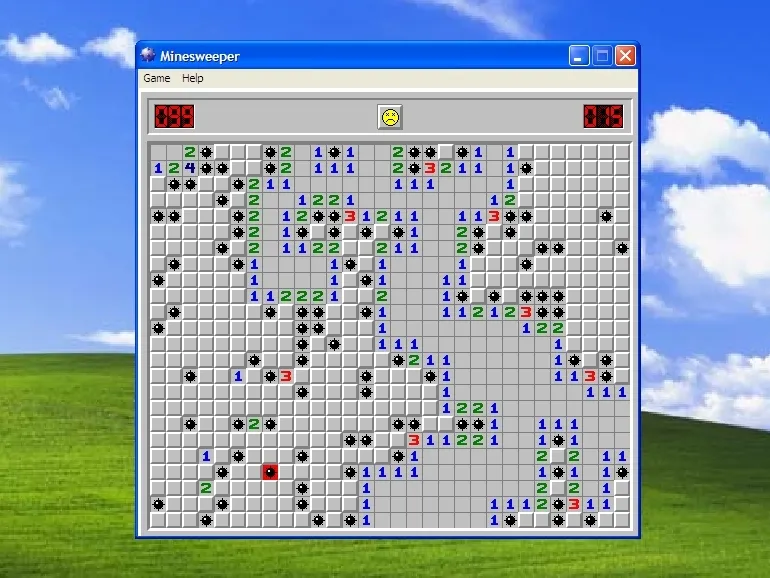
The goal of Minesweeper is to uncover all the squares on a grid that do not contain mines without being "blown up" by clicking on a square with a mine underneath. The location of most mines is discovered through a logical process, but some require guessing, usually with a 50-50 chance of being correct.
Clicking on the game board will reveal what is hidden underneath the chosen square or squares. Some squares are blank while others contain numbers (from 1 to 8), with each number being the number of mines adjacent to the uncovered square.
To help the player avoid hitting a mine, the location of a suspected mine can be marked by flagging it with the right mouse button; however, if a player is unsure if a square is safe or not, they can tag it with a question mark (?). The game is won once all blank or numbered squares have been uncovered by the player without hitting a mine.
In early versions of the game, a cheat code let players peek beneath the tiles. By the year 2000, the game had been given the name of Flower Field instead of Minesweeper in some translations of Windows Me and Windows 2000, featuring flowers instead of mines. Flower Field's gameplay was otherwise unchanged.
The "Flower Field" version of Minesweeper, developed by Oberon Media, shows a garden blooming when the game is lost. It is the default in specific distributions of Windows. The game's color scheme changed with the release of Vista, and the icons were updated to match the Aero look.
Microsoft removed Minesweeper from Windows 8 and instead published it as a free game on the Microsoft Store. The new version is developed by Arkadium and is ad-supported.
Business Insider called the game an "iconic part" of the Windows operating system.